
Chronicles of Vincent van Gogh, 4
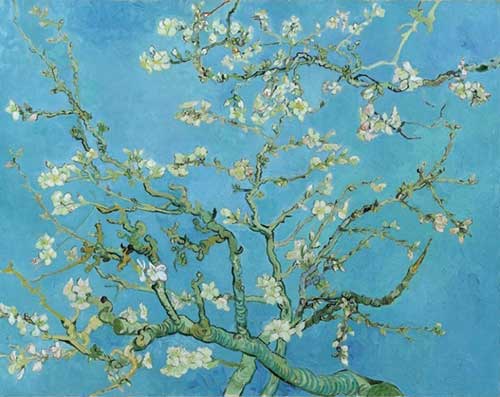
18. Van Gogh honors the birth of his nephew, whom he named after himself, with the first painting of a flowering almond tree in the West
As much as Van Gogh thought of his brother, Theo’s affection for him was equally strong. When Theo gave birth to a son, he named him Vincent Willem van Gogh after his brother. Through his son’s name, Theo was sending a message of affection and support for his brother. When Van Gogh heard that his nephew’s name was the same as his own, he was overjoyed, but also secretly afraid that his nephew would be as unhappy as he was.
However, he painted a painting to wish his nephew a happy birthday and gifted it to him, The Almond Tree in Bloom, which is now considered a masterpiece. The almond tree is one of the first trees to blossom in spring, and in this painting, Van Gogh depicts not only full-blown flowers, but also buds that are just beginning to emerge, as if to celebrate the birth of life. Van Gogh worked so hard on this painting that he was said to have been sick for several days after completing it.
19. For the first and last time in his life, he hears that his paintings have been sold
During this time, however, Van Gogh received one piece of good news after another: ten of his paintings were accepted into the Salon d’Artistes d’Andépendants, an art exhibition that began in Paris in March 1890. A letter Theo wrote to Van Gogh at the time gives us an insight into his assessment of the paintings and the mood of the exhibition.
How happy I would have been to have you at the exhibition. Your paintings are well arranged and very good. Many people have come to ask me to praise you. Gauguin said that your paintings were the centerpiece of the exhibition.
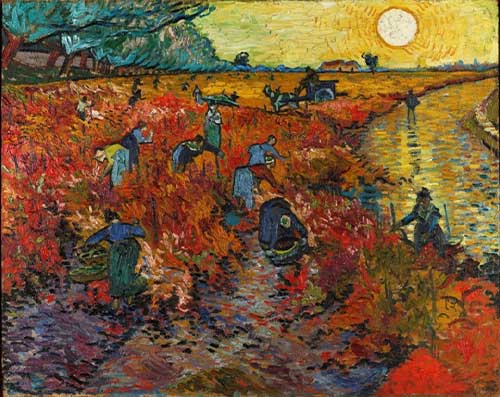
Around the same time, six of Van Gogh’s paintings were featured in an exhibition in Brussels, Belgium, and it was here that the first Van Gogh painting was sold. <The painting, The Red Vineyard (now owned by the Pushkin State Museum of Fine Arts in Moscow), with its vibrant colors, brushstrokes, and vivid depiction, was the first and last painting to be sold during his lifetime. It was sold to fellow artist Anna Bosch for 400 francs. Twenty years later, a Russian named Ivan Morozov bought the painting for 30,000 francs, and it is now owned by the Pushkin State Museum of Fine Arts in Moscow, where it is currently valued at nearly $80 million with insurance, or about 23,750 times more than it was when it was first purchased.
20. Van Gogh ends his life by shooting himself at age 37
Although people were finally beginning to recognize his work, Van Gogh’s physical condition continued to deteriorate, and his mental state was taking a turn for the worst. In May 1890, ten years into his painting career, Van Gogh moved to a place called Aubers, near Paris, to seek treatment. The Auberge was close enough to Paris that he could easily visit his brother Theo, and a doctor Theo had introduced him to, Dr. Gachet, agreed to take care of him there. At the Auberge, Van Gogh once again worked almost a painting a day. However, after The Red Vineyard, there are no more sales and the health of his brother Theo begins to deteriorate.
Van Gogh’s confidence in the future fades, and he grows weary of his constant bouts of mental illness. Finally, on July 27, 1890, he walks into a cornfield with an old gun and pulls the trigger on himself, aiming for his own chest. But the bullet misses, and Van Gogh returns to the inn bleeding to death.The innkeeper, noticing Van Gogh’s condition after hearing his groans, rushes to call a doctor, but there’s nothing more he can do.The next day, Theo, having heard the news, rushes to visit Van Gogh, and it’s then that Van Gogh blames himself, telling Theo: ‘Why am I so good?
“Why am I not so good at anything? I can’t even fire a gun at myself.
Theo could only sit by the small attic bed and watch the dying artist in a daze, and at 1:30 a.m. on July 29, 1890, Van Gogh died in front of Theo’s eyes at the age of 37.
21. Theo’s wife, Johanna, orchestrates a stunt to publicize Van Gogh’s work
But even more tragic than Van Gogh’s death was the fact that six months after his death, his brother Theo also succumbed to an illness.With his brother, who knew him better than anyone, gone, how did Van Gogh become so famous posthumously?
It was Theo’s wife, Johanna, who helped turn Van Gogh from an unknown painter into one of the world’s most beloved celebrities. Johanna knew that her husband Theo wanted people to know about his brother’s work, so she devised a strategy to fulfill his wishes.
The first was to increase the value of Van Gogh’s paintings.
In 1905, 15 years after his death, a retrospective of Van Gogh’s work is held at the Rijksmuseum in Amsterdam, featuring more than 480 of his paintings. Johanna sells Sunflowers to the National Gallery in London, a world-class, highly trafficked museum that allows anyone to see Van Gogh’s masterpiece. Rather than being the property of the wealthy few, it becomes a public good, and the painting becomes even more valuable.
‘It is difficult, I think, to deny or question the naïve sincerity of his art, the originality of his vision’ -Criticism of Van Gogh’s work in 1890
It wasn’t until 1890 that Van Gogh’s paintings began to receive the attention they deserved, but unfortunately, he died that year. Not long after his death, the Impressionists began to sell their works, and Johanna felt that if she had waited a little longer, Van Gogh could have seen the light of day. Johanna’s strategy of making Van Gogh’s great works more accessible to the public in this way increases their value, and she succeeds in getting Van Gogh’s name and work out there.
The second was to create a story.
In addition to the paintings that Johanna inherited, her husband Theo had letters from and to his brother Van Gogh, which Johanna collected and published in a book in 1914. The story of the brothers makes the artwork more immersive and deeply moving.
Van Gogh and Theo are now buried side by side in the Auberge, but Theo’s grave was originally located elsewhere. Johanna moved Theo’s grave to be next to Van Gogh’s, further emphasizing the brotherhood. To this day, visitors to the brothers’ graves still lay sunflowers to honor their memory.
Thanks to Johanna’s curation, Van Gogh’s paintings become even more tragic and beautiful as they come together with the story.
Thanks to Van Gogh’s great work and Johanna’s marketing genius, the artwork gains the global fame it has today.
22. Van Gogh’s nephew, Vincent van Gogh Jr. inherits his uncle’s name and opens a museum named after him
After Johanna, there was another person who would go on to make a name for himself: Vincent Willem van Gogh, the nephew who inherited his uncle’s name and looked just like him. In 1973, Van Gogh Jr. opened his uncle’s museum in Amsterdam, the capital of the Netherlands.
Van Gogh wanted to be recognized for his work, and through another Van Gogh, he was able to fulfill that dream. In this way, Van Gogh’s paintings became famous and are still loved around the world today, thanks to those who knew him.
With more than 800 oil paintings and 1,300 drawings in his short decade-long career, it’s safe to say that Van Gogh was passionate about his art and gave his life and soul to his paintings.

