
Chronicles of Vincent van Gogh, 3
11. Van Gogh, 35, dreams of a community of painters in the Yellow House
The use of tube paints allowed Van Gogh to paint with his own colors, which gave him another goal. He wanted to turn his yellow house into a community of painters. Despite his lack of interpersonal skills, he hoped to create a community where artists could come together and help each other improve. He felt lonely, especially in his isolation and solitude, and he needed companionship to fill his loneliness. So he began sending out invitations to artists in Paris, and one of them responded: Paul Gauguin, the artist who would later become known as the leader of the French Post-Impressionist movement, best known for his famous painting, The Women of Tahiti.
Gauguin was born in Paris, France, but spent his childhood in Peru, South America, before returning to Paris to work as a stockbroker. In 1882, the Paris stock market crashed when the Paris Stock Exchange went bankrupt, and Gauguin, who had always been interested in art, decided to become a painter. His brother Theo then sponsored Gauguin, and the two met for the first time in Paris in 1887.
Gauguin felt a kinship with Theo, who, like Gauguin himself, hadn’t attended art school and started painting late in life, so Gauguin was keen for him to join the community of painters that Gauguin himself was leading. Gauguin wasn’t too keen on the idea, but when Theo told Gauguin that if he went down to Arles and stayed with him, he would pay for his living expenses, Gauguin decided to move to Arles. At the time, Théo was giving Gauguin about 300 francs a month to stay with him, which was enough for the two of them to live comfortably.
It is speculated that Théodore’s reason for supporting Gauguin, even at the expense of more money, was actually to support his brother. Theo knew better than anyone how lonely Gauguin was in Arles and how eagerly Gauguin waited for him as the brothers exchanged letters.
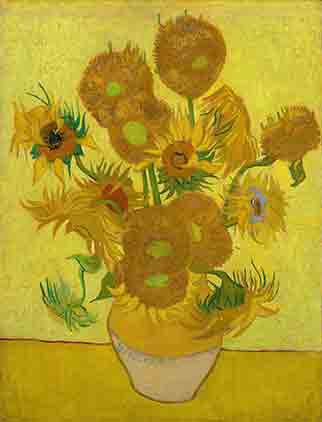
12. Van Gogh paints four Sunflowers to decorate Gauguin’s room
Finally, Van Gogh received word from his brother Theo that the long-awaited Gauguin was coming to Arles, and from then on, Van Gogh busied himself with preparations for his guest.
Van Gogh decorates Gauguin’s room with a painting of his own, Sunflowers. One of the paintings that comes to mind when you think of Gauguin is Sunflowers, and these four sunflowers were originally intended as a gift for Gauguin to decorate his room.
The story goes that Gauguin wanted to fill his room with sunflowers, but he didn’t have the stamina, so he only prepared four. Gauguin completed these four paintings in just seven days, from August 20 to 26, 1888. Van Gogh wondered what if Gauguin didn’t like the quiet, rural town of Arles and decided that he needed something special to catch Gauguin’s eye, so he decided to paint a special painting for Gauguin, a sunflower. Van Gogh chose the sunflower, among many other flowers, because it was native to South America, where Gauguin spent his childhood. It was a nostalgic flower for Gauguin, and Van Gogh remembered this when he gave Gauguin the painting. For reference, the sunflower is said to be a symbol of health, life, and money in Europe.
Gauguin finally arrived in Arles on October 23, 1888, and he must have been somewhat excited at first because of Gauguin’s warm welcome. The two hit it off, painting together every day and sharing stories.
13. Van Gogh and Gauguin’s relationship begins to fall apart due to their stark personality differences
However, their peaceful relationship doesn’t last long. Gauguin’s dissatisfaction with Van Gogh began to build, and Van Gogh’s words began to sound nagging at some point. Van Gogh would point out that Gauguin would leave his paints out to dry in a messy mess, and he would express his frustration. He was also known to be a poor cook, and stories have it that he would serve up tasteless soup, which was one of the causes of their fights. The two men’s vastly different personalities caused their relationship to deteriorate. You can get an idea of how different Van Gogh’s and Gauguin’s personalities were by looking at the paintings they created at the time. Add to that the fact that their worldviews were so different, and you can see how their relationship began to deteriorate over time, with frequent disagreements.
14. Van Gogh is Disappointed by Gauguin’s Portrait of Himself
In a letter to Theo, Van Gogh, who was suffering from hallucinations and neuroses at the time, wrote: ‘When I fight with Gauguin, my head feels like a discharged battery.
‘When I fight with Gauguin, my head is as empty as a discharged battery’
When Gauguin became extremely excited, he would have seizures and hallucinations, and when he later regained his senses, he would not remember them, leading Gauguin to believe that he was already losing his mind. One day, about two months into Gauguin’s stay in Arles, Gauguin offered to paint a portrait of Gauguin, and Gauguin wrote to his brother Theo about how he felt about the news.
‘Gauguin is painting my portrait and I think it will be his masterpiece that will not go unnoticed’
In response to the painting, Van Gogh expresses his disappointment with the painting, saying
‘It’s me, but it’s me gone mad’
Gauguin wanted him to stay in Arles despite the clash, but then Gauguin heard that his paintings were being sold in Paris and decided to leave Arles.
15. Gauguin leaves, has a seizure, and cuts off his own left ear
Tensions were extremely high between Gauguin, who wanted to leave for Paris, and Gauguin, who wanted to hold him back, and then on December 23, 1888, a terrible event happened that no one could have predicted. Gauguin had left for Paris after an argument with Gauguin, and following a seizure, Gauguin cut off his own left ear with a razor blade. It was rumored at the time that Gauguin’s departure and Theo’s marriage had led Gauguin to believe that Theo would also leave him.
16. At age 36, Gauguin checks himself into the Saint-Rémy Asylum
Van Gogh then remains alone in the empty house Gauguin left him, in despair, and begins to paint again. One of the paintings he created during this time is a self-portrait with a bandaged ear. In this painting, he has drawn an “easel” behind his figure, showing his determination to get back on his feet as a painter.
Gauguin made various efforts to recover his body and mind in order to paint again, but his mental illness continued to recur, and in May 1889, at the age of 36, he was committed to the Saint-Rémy Asylum.
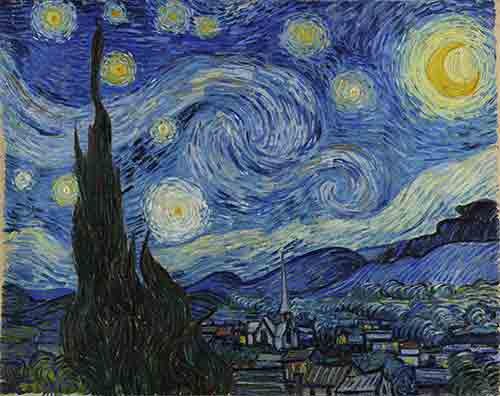
17. Van Gogh continued to work despite his deteriorating health in order to support his brother Theo, who helped him financially.
After being hospitalized in an asylum, Van Gogh suffered from anxiety and seizures, but he continued to paint as he looked out over the landscape beyond the bars of the asylum. This is where his masterpiece, Starry Night, was born. It is believed to have been painted while he was in the asylum, watching the sun rise. To the left of the painting is a ‘cypress tree’ rising into the sky as if on fire, which is a symbol of mourning in Christianity because it was the tree from which crosses were made in the Roman Empire. Van Gogh appears to have drawn the tree arbitrarily, and it is possible that he was contemplating life and death and incorporated it into the painting.
The night sky is painted in blue with a complementary contrast, which is a typical feature of Van Gogh’s painting style, and the stars and moon are painted in yellow to express the vivid night sky, and the meticulous handling of each brushstroke is also a highlight.
Van Gogh painted around 150 paintings in the year and spent a night in the Saint-Rémy asylum after arriving in Arles, during which time he worked at a rate of almost one painting every three days, and he himself explained why he was able to produce so many paintings despite his poor health.
‘What I have to remember about money is that if a man spends 2,000 francs a year for 50 years of his life, then in my lifetime I have spent 100,000 francs, and he should earn 100,000 francs. As an artist, you have to paint 1,000 paintings for 100 francs in your lifetime.
Van Gogh felt very bad about being financially dependent on his brother Theo, so he calculated how many paintings he would need to paint at 100 francs each to pay off the debt he owed Theo. In the end, in the decade leading up to his death, Van Gogh produced around 800 oil paintings, and he had almost achieved his goal of 1000 paintings by the time he died.

