
Chronicles of Vincent van Gogh, 2
7. Van Gogh begins to capture the brightly colored Paris of the Impressionists.
It was during this time that Impressionism was shaking the city. Moving in with his brother Theo in Montmartre, he began to study painting in earnest in Paris. It was during this time that he began to associate with the Impressionists and his painting changed. <Paris Landscape was painted before he met the Impressionists, and Boulevard Clichy was painted after he met the Impressionists and tried to change his style.Unlike the dark and heavy paintings like The Potato Eaters, his paintings from his time in Paris after meeting the Impressionists are brightly colored. Under the influence of Impressionism, he uses vividly colored paints without mixing them with other colors to capture the landscape of Montmartre.
Van Gogh receives support from the ‘tangible inspiration’ of the fireballs
In Paris, Van Gogh’s passion for painting was ignited. But even though he was supported by his brother Theo, there was one thing he always lacked: paint.
As he began to use more color, paint became even more scarce, until he met a helper who gave him a supply of paint or a canvas. Van Gogh was so grateful that he painted a portrait of him, which he called his “tangy inspiration,” a Parisian fire pit man. Famous painters such as Cézanne, Renoir, Monet, and Gauguin were regular patrons of the Tanguy Inspiration, who, along with his brother Theo, was a strong supporter of Van Gogh.
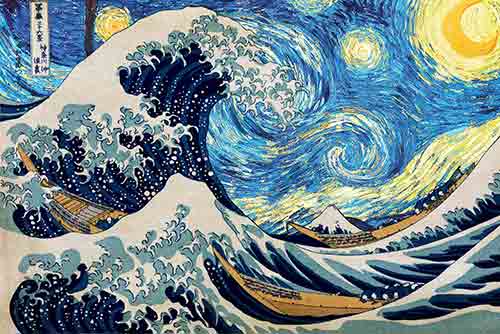
8. Van Gogh begins to fall in love with ukiyo-e, the brightly colored Japanese printmaking style
When you look at Van Gogh’s colorful painting of the Tangier-inspired Portrait, you’ll notice something that’s a bit foreign to European sensibilities. Behind the tangy inspiration, there are scenes of geishas, Mount Fuji, and more. In fact, before coming to Paris, Van Gogh had already encountered Japanese art in Antwerp, Belgium, which was a major trading port for Japan, and by the time he came to Paris, Japanese art had already reached Paris through the World’s Fair, so his interest in Japanese art grew. It was during this time that Van Gogh became even more fascinated with ukiyo-e, created several paintings featuring it, and even copied several works.
9. At 35, Van Gogh reaches his peak in Arles, France
After two years of many twists and turns, Van Gogh’s experiences in Paris confirm his qualities as a painter, and he leaves the city to seek new inspiration during one of the most turbulent periods of his life. Van Gogh’s favorite city, Arles, is located in southeastern France, in the artistic and romantic Provence-Alpes-Côte d’Azur region. Why did Van Gogh leave Paris for Provence, in the south of France?
The truth is that Van Gogh expected his paintings to sell in Paris, but despite the efforts of his art dealer, Theo, not a single painting sold.
He needed a way out of this crisis. He thought of Japan as a warm place with an intense sun, which is why he created intense works like Ukiyo-e, and he wanted to find artistic inspiration in the warm south. Finally, in 1888, at the age of 35, when he had been a painter for eight years, he traveled to Arles in the south of France. Shortly after he arrived in Arles, spring arrived and the trees began to bloom.
Inspired by the intense sunshine and the vivid colors of the natural landscape, Van Gogh went straight out with his paintbrush and spent the day capturing the scene in his canvases.In May of that year, Van Gogh found the perfect place to immerse himself in painting: the Yellow House, the artist’s favorite sanctuary and studio. Van Gogh fell in love with the house and contacted his brother Theo to ask him for money to buy it. Theo agrees to rent the house without even considering the price because Van Gogh has painted it yellow before the contract is signed.
Van Gogh liked the house so much that he painted it yellow before he even asked Theo for permission, making it a yellow house, and Theo had no choice but to rent it to him.
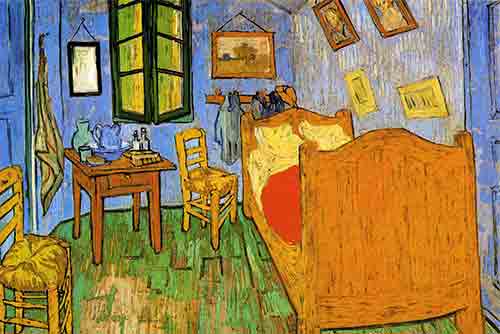
After The Yellow House, Van Gogh also painted his own room, and this painting, called Bedroom, depicts a room on the second floor of the Yellow House.
Van Gogh’s room was trapezoidal in shape and narrow with angled corners, and he loved it and enjoyed sitting on his bed, smoking his pipe, and contemplating. When you look back at Van Gogh’s nomadic life, you can see why.
He moved a total of 37 times in his 37 years of life, so it’s almost like he moved once a year.So when he arrived in the city of Arles, he was thrilled to have a workspace of his own for the first time, and he loved it.He showed his love for his room in his paintings, and by this time he had settled down. While in Arles, he painted numerous paintings and gradually began to find his own style, and many of his most famous works were created during this time.
<Beginning with this painting, one of Van Gogh’s most famous works, known as The Cafeteria, Van Gogh’s signature use of complementary colors is employed.
Most of the time, the night sky is represented in black, but Van Gogh painted the sky in blue and boldly used orange and yellow, colors that are rarely paired with blue. Blue and purple, contrasting with yellow, are complementary colors that are rarely used in traditional art because they are too bright, but Van Gogh boldly uses them to create the feeling of night. I think Van Gogh was probably the first to paint a nighttime street in such a warm and welcoming way.
Another great example of complementary color contrast is one of Van Gogh’s greatest masterpieces, The Starry Night in Arles. It depicts a couple strolling along the street, and like his cafeteria, Van Gogh painted the night sky in a deep blue, with the Big Dipper shining brightly against the blue sky in its complementary color, yellow. The texture of the paint, which looks like it’s been brushed on, gives the impression that the night sky is in motion. Van Gogh’s generous use of paint creates a rich texture that is very well spread across the river.
10. Turning Points in Art The Birth of Tube Paints
There was a reason why Van Gogh was able to paint the landscapes of Arles to his heart’s content: the invention of tube paints.Before the invention of tube paints, painters used to store their paints in the bladders of animals such as cows and pigs when they went out to paint.
This was fine for indoor storage, but it was bulky and often burst, causing paint to leak out.Then a painter named John Goffland invented the tube container, patented it on September 11, 1841, and it gradually became commercially available.Thanks to tube paints, impressionist painters like Van Gogh and others were able to paint landscapes outdoors to their heart’s content.
‘If there had been no tube paints, there would have been no Monet, no Cézanne, no Pissarro and no Impressionism’ Auguste Renoir (Impressionist painter)

